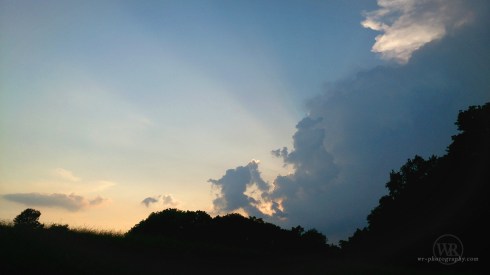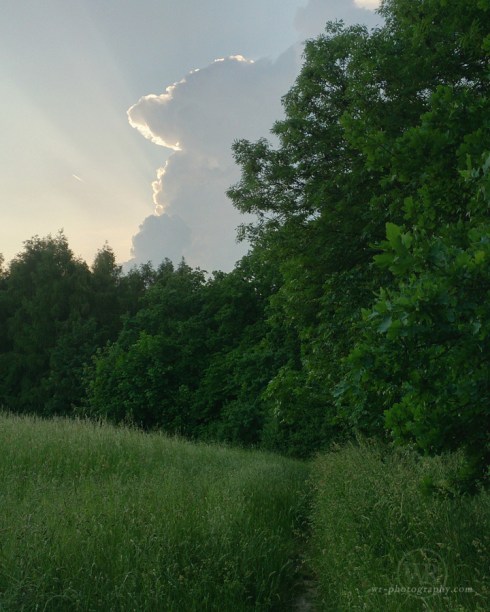
Visiting a sunflower field, before venturing on to gather wild herbs and rowan berries. I recharge and absorb the warmth of the evening sun. The temps have dropped to a chilling 12 °C. Going deeper into the sunflower field, a bee, stiffened from the cold, is stuck to a huge sunflower head. I wonder if it will make it through the night. It would wake up to plenty of food though. A few seconds later the sun has vanished and the sky is ablaze…
Bees on our White Lavender
11 JulEvery year, dozens of bees and bumblebees are collecting nectar and pollen on our white lavender. Now is that time again. The above photo was a lucky shot. My lens is not really suited for macro photography. But in this image all the details of the insect are clearly visible, whereas the surrounding has a nice bokeh effect, created by motion blur and depth of field. So here we go, another bee joins the “flower devils” photo series.
Back at the Blackthorn Gate
2 Jun
The sunset that evening

The grass on the meadow in full bloom; everything smelled like summer

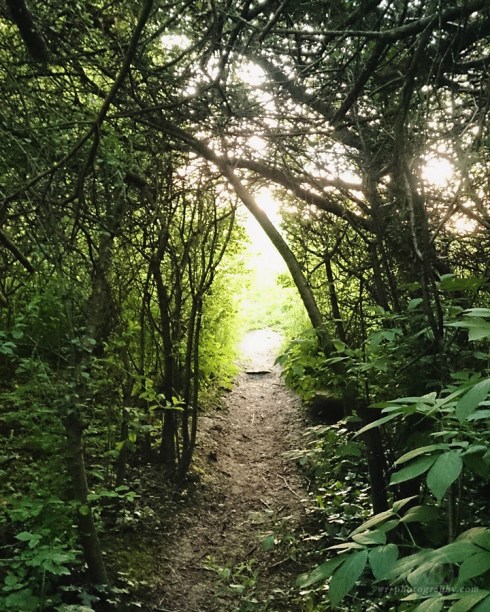
The Blackthorn hedge forms a gate around a beaten path. As the former hedge slowly grows into trees, they begin to wither from within, whilst new blackthorn shrubs grow on the outside. With the years a dense thicket is formed, where birds and other animals find a home.

A poison hemlock plant, found on a meadow. The purple spots on green stem and pungent smell easily distinguish it from other umbelliferous plants.
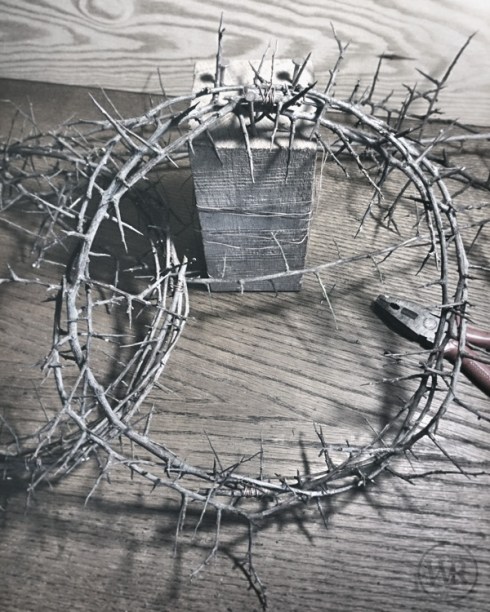
From the gathered blackthorn branches thorn-crowns are made. I’ve been working with the blackthorn for over a decade; since three years I am returning annually to gather branches for making these thorn-crowns. This year I gathered material for making four to five crowns. Two are already reserved. E-mail me if you are interested in receiving one as well.
Fingers II
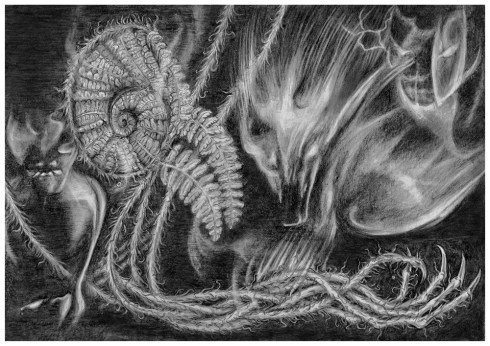
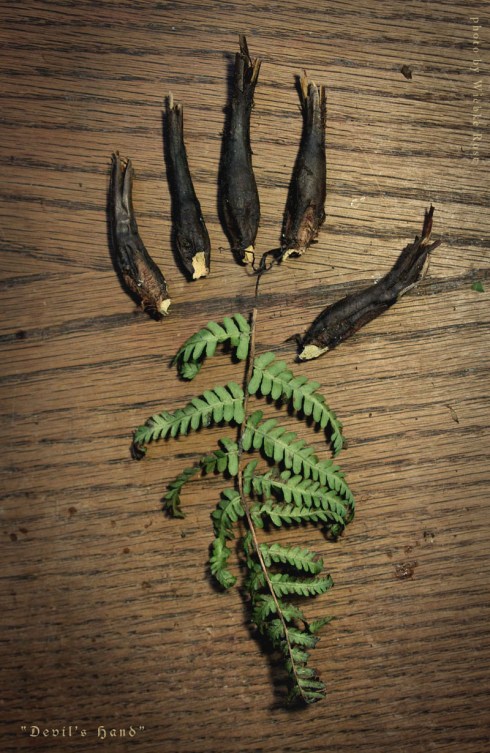
9 AprThis time it is not about a surreal dream and also not about the fennel. But it is about another plant’s “fingers”. In folklore the male fern’s “hand” is a lucky charm, meant to bestow fortunes and the power over the souls of the dead to it’s owner. In order to obtain it, the sorcerer must harvest the male fern’s root on the Eve of St. John. Then he must roast the root in the fire. The hand is made in such manner as to bind five strands of the fronds together: the root base of the stem is left attached and the rest of the frond’s foliage is removed. The result resembles a “hand”, with tendons (hairy stems) and fingers (stipe bases). Frankly, I never made such “hand” in this manner. But I’ve gathered plenty of male fern roots and had the most magical experiences granted through working with these roots in various ways, always discovering new aspects to this wondrous plant. Above is another version of this “lucky hand”, formed by the stipe bases and a single frond.
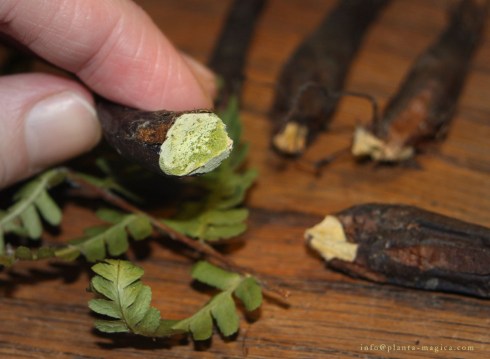
Btw., the stipe bases of the male fern’s fronds are green and spongy towards the center, whereas as the outer (old) parts turn black and rot. So if you were to use the root, make sure you actually use the parts that still have juices in them. Below is a close-up of how that should look:
More about the male fern
Male fern inspired art:
Foetid Devil
8 Mar
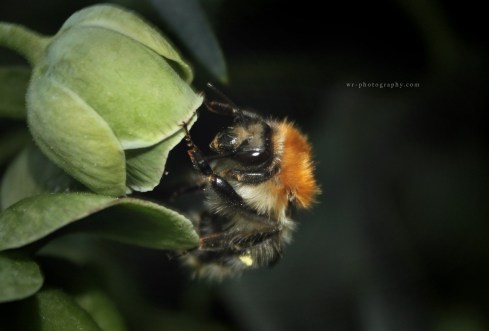
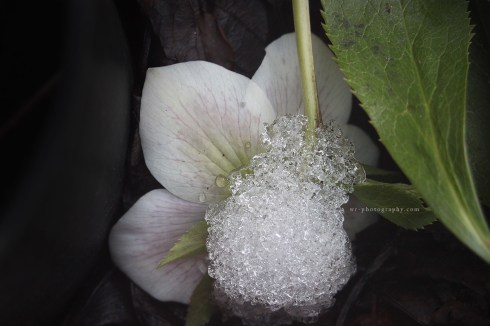
Common Carder Bee (Bombus pascuorum), on Stinking Hellebore (Helleborus foetidus) flower
Schnee von gestern
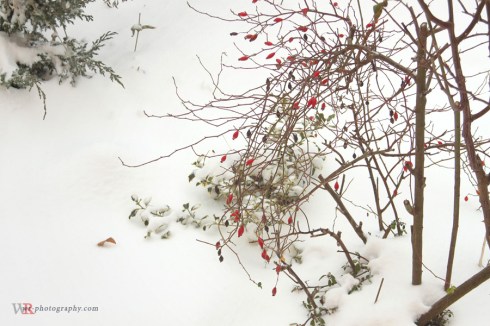
24 JanI took the photos yesterday, fascinated by the contrasts and white spaces that function as a visual divider in the compositions of the images. Some people are afraid of empty spaces. In visual art, horror vacui (from Latin “fear of empty space”), also kenophobia, (from Greek “fear of the empty”), is the filling of the entire surface of a space or an artwork with detail. (see https://en.wikipedia.org/wiki/Horror_vacui)
I am thankful for any gap, any empty space. The white of the snow has a calming, purifying effect on me. Sadly it’s already gone. Literal snows of yesteryear.
Winter Walk: Sacred Thorn Grove, January’s Mysteries and the Bloody Tears of the Cherry Tree Sisters
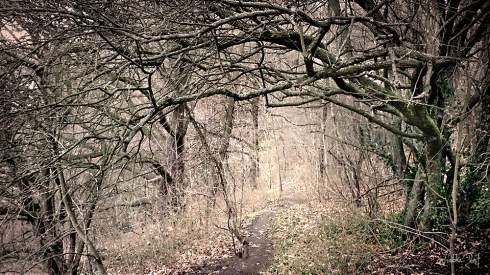
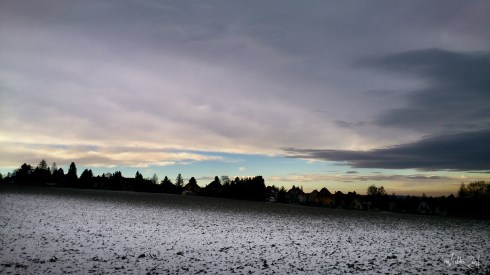
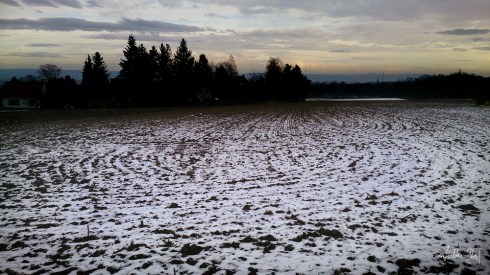
14 JanSteady-paced I walk up the hill. The air is pleasantly cold. It clears the mind and disperses my headache. I am not freezing. The road I’m walking up is called Am Kirschberg, literally meaning “by the cherry mountain”. The field to the left is covered with a thin layer of snow. The dark frozen soil is sticking out of the white. Ploughing traces create zen like, eye-dazzling patterns. At the end of the long stretched field the view is clearing up towards town. Over the horizon line a narrow golden band illuminates the sky. Above me are grey clouds. I am planning on a short walk, but my legs carry me in a different direction…
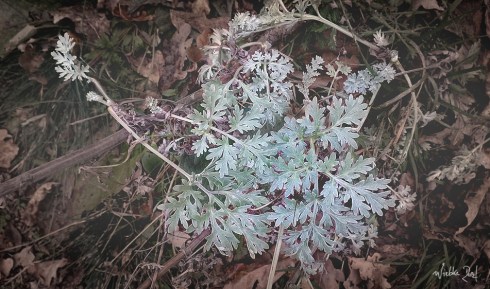
Atop a stone wall by the castle, I find the wormwood has not entirely fallen victim to the frost. Next to fading foliage, fresh silvery green leaves are sprouting forth. I gather a few of them, enough for a small winter herb bundle to hang up at home. When dried, it will empower necromantic incense blends. Looking across the river valley, remnants of snow are showing between leafless trees and dark rocks. The sky is an eyeful and I would enjoy the silence, if it wasn’t for cars flashing past on a mint-green autobahn bridge.
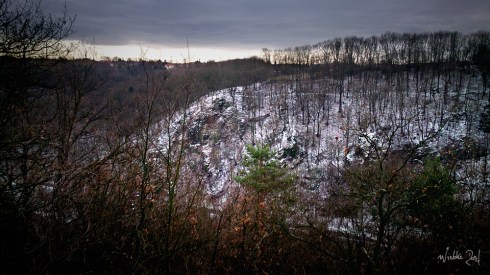
The Thorn Grove in Winter
The way down is frozen over and I hold onto the rusty handrail in order to not slip and fall. People coming my way do not greet me and I do not greet them either. Halfway down the hill, I arrive at the thorn grove. The path up there leads through leafless hawthorn trees growing in all directions. A jay sitting in the branches looks at me but does not fly off. Cautiously I venture on. The ground is muddy and slippery. Most of the snow at this side of the hill has melted. By the rocks I find another wormwood plant and spot a bird’s nest near where the jay had been. I am looking around, breathing the fresh winter air, trying to focus my myopic eyes on the distance. I think of none. It is a good place for the soul.
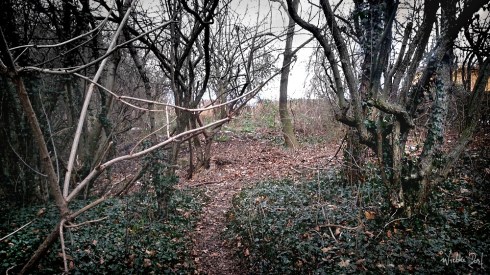
Above, the hawthorn thicket is overgrown by raspberry and wild rose. To the right there are young blackthorn shrubs. Their thorns are long and sharp. The young twigs are flexible and make the best thorn-crowns. Further uphill, there is another areal of high-grown hawthorn trees, partly covered in ivy. It’s bordering at a property and the allotment gardens are close. One is likely to meet passersby here. But a magician knows to use the gaps and at night the place is dead silent. Today, however, I am only a passerby myself.
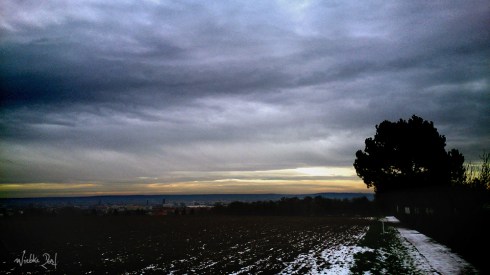
A Thin White Veil upon the Field
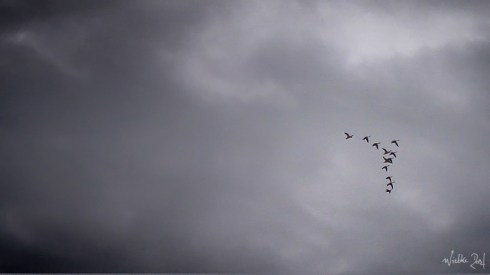
I’m on my way home, stopping now and then, intrigued by the formations of clouds and the golden light of the sun further afar. A skein of geese is on its way southwards. Passing by wild cherry trees lining the field, I search their stems for resin and at last find a group of three tall and slender trees, the base dripping with soft, blood-red gum. I memorize the spot and proceed, faster now. I have to watch my steps. The trail is akin to an ice rink.
At the birch tree, I stop once more. From here the field looks softer…
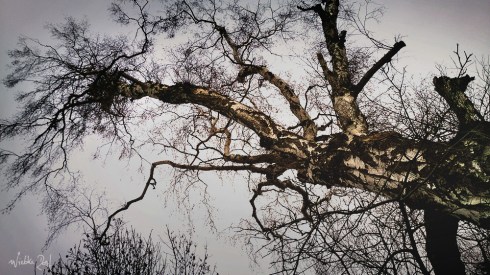
The birch is a pioneer, a tree of new beginnings and the first to come back after complete devastation. The birch profits from death and desolation, but it also paves the way for others to follow and thrive. Beith is for birch, the tree of January, the door opener.
Remnants of snow on the barren field, remind of the birch’s torn bark. It starts raining and continues to do so. The next day the snow will be gone.
The Blood-Red Resin Tears of the Cherry Tree Sisters
Returning to the cherry trees, the resin is moist from the rain water and easy to scrap off. I collect a jar full, which I later place on the heat. The resin dries and hardens quickly. In its soft state it is sticky and a yellow golden color. It smells remotely of ripe cherries and of caramel, when burnt. In German it is also known as Katzengold, literally “cat’s gold”, and used for sweetening cough tea. In my worship, I employ the dark red resin tears for Naamah and other female entities. In their harvest, take care to not take everything and leave some behind for the spirits, along with offerings for the guardians of the trees. Physical gifts are symbolical and in order, but they count none without respect and patience. The latter are the true sacrifice. The trees will remember your signature and recognize you next time you approach them.
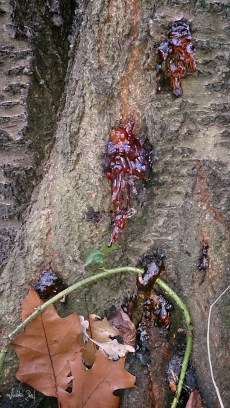
I am thankful. The thought had crossed my mind to scar the trees in order to gather their resin. But I have not done so. Therefor I am blessed.
Concerning the Wood Wide Web: http://www.bbc.com/earth/story/20141111-plants-have-a-hidden-internet
New Plant Riddle
14 OctSharing this here as well…

The game is as usual: guess the plant depicted and leave a comment with your suggestion! If you have been following my recent postings on my new herbalism blog you will easily find the plant in question. A hint: it has to do with autumn. 😉
Lunar Eclipse September 2015
1 OctThis was a very special event for me and a dream come true. I have experienced the “blood moon” that occurs during a lunar eclipse intensely and in different ways before, each time doing workings of a different nature. But I have never actually seen one. Instead clouds and bad weather. Would tonight be different?
It didn’t look like that. Half asleep I traveled through a near empty town at 2 am in the night and walked the dark way up to the observatory in Radebeul, worried, since all I could see were clouds. I arrived about 3.20 pm. I had been alone all the way and was surprised to find that quite a few other night owls and moon addicts were already present. The sky wouldn’t clear up. Instead we got to enjoy a presentation of impressive photos taken during former eclipses, such as the lunar eclipse of 2007, 2010 and 2011 as well as the Venus transits of 2004 and 2012, and then moved on to the planetarium…
Just as the projection started came the news we all had been waiting to hear. At once all ran outdoors to catch a glimpse of the reddened moon as it was just entering the earth’s umbra. A few minutes later the beginning spectacle was again covered by clouds. Some went back inside for the projection. I decided to stay and wait…
Temperatures had gone down to 5 °C, the South-Western sky was dark and cloudy. Occasionally a thin silvery sickle and finally only a dark red spectre gleamed up behind black clouds only to vanish again in darkness a few seconds later. It was still mesmerizing to watch, as if the bleeding moon wanted to hide and veil itself as it fully immersed in the shadow of the earth.
I took some more or less blurry photos during this period, which are pasted into one image below. But the truly spectacular moment was when the moon emerged from the earth’s shadow. This was also the moment I captured through the telescope and which you see on the title image. This photo would not have been possible without the help of Martin and the rest of the team at the Sternwarte, who offered their telescopes and qualified advice to other attendants.
On this night I also got to observe other celestial bodies. This being my second visit to the observatory, the solar eclipse in March now followed by the lunar eclipse of September, which was closing the cycle of eclipses for this year.
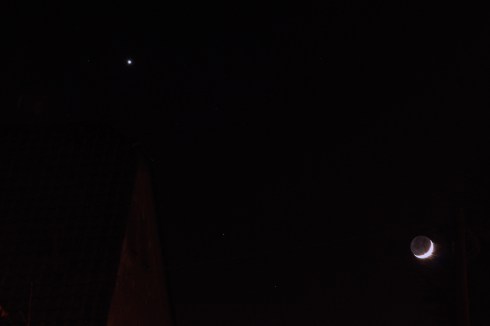
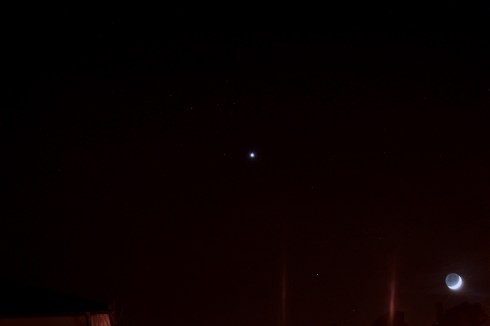
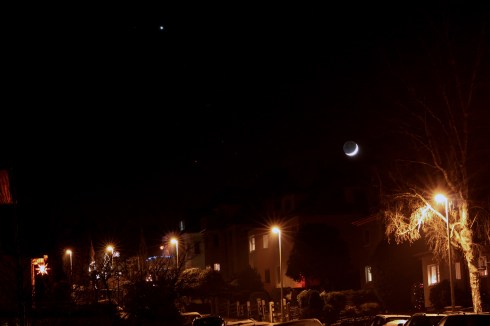
As the Northern sky cleared up we were shown for example galaxies M 82 and M 83. Venus rose above the planetarium, followed by Mars (then located beneath Regulus and the constellation Leo) and Jupiter, who’s moons and bands could be seen through the large reflecting telescope. Below you see the three planets align above the planetarium in the East. They will be joined by Mercury in October.
Further South-East the Orion nebula was barely visible with the naked eye but through the telescope one could clearly see the luminescent “wings” of the gas cloud as well as four bright stars across the nebula, which I assume were the trapezium cluster. The “nebula” is also known as M 42. It is part of a large gas cloud spanning all the way through Orion, but only parts of this cloud are visible. We learnt back in the days of renaissance astronomy and comet hunting anything that was not a comet and could not be defined nearer was called a “nebula”. Today we know new stars are born inside the gas cloud, which ionize the surrounding hydrogen molecules, causing them to beam.

Endende Mondfinsternis und Zeiss Coudé Refraktor, 28 September 2015, Volkssternwarte Adolph Diesterweg, Radebeul
In the meantime the sky had cleared up and we could now see the moon in all its glory, as it was exiting the earth’s umbra and penumbra before setting in the West. At dawn we were also rewarded with a magical view over the Elbe valley, where fog was gathering and the city was slowly waking up.

Nebel über dem Elbtal, 28 September 2015, Blick von der Terrasse der Volkssternwarte Adolph Diesterweg, Radebeul
Exhausted and happy we waited for the sun to rise.
Sternwarte Radebeul: http://www.sternwarte-radebeul.de/