Archive | nature RSS feed for this section

World Goth Day, Observation and Contemplation

23 May

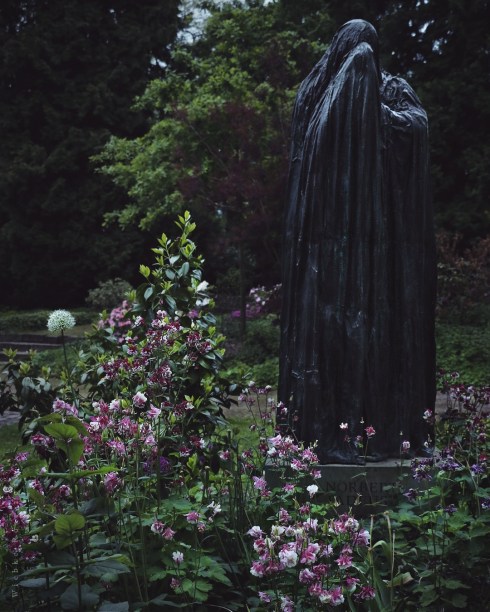
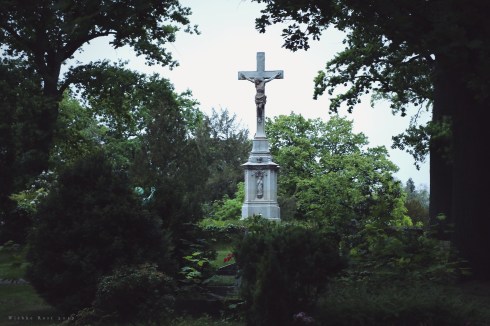
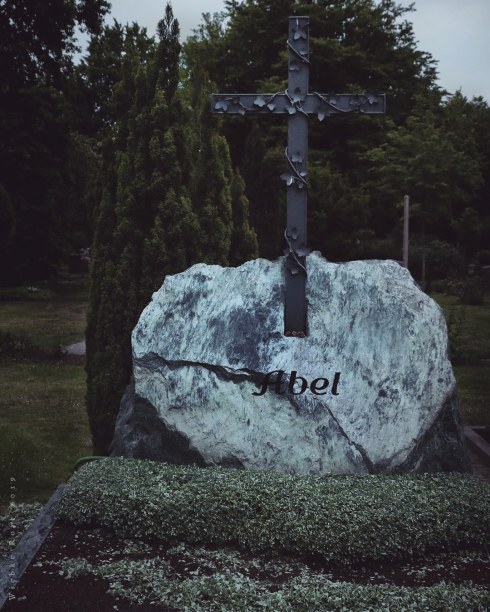
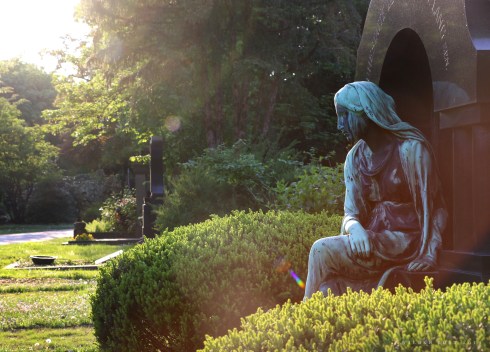
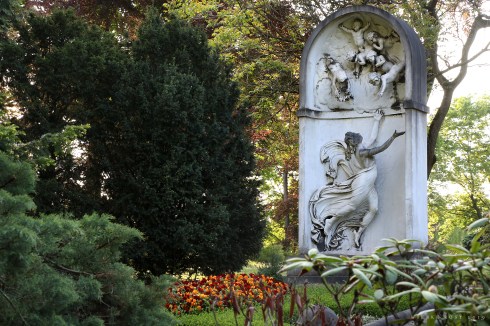
Another exploration of Düsseldorf’s Nordfriedhof, in the twilight of the evening hour and short before rain set in.

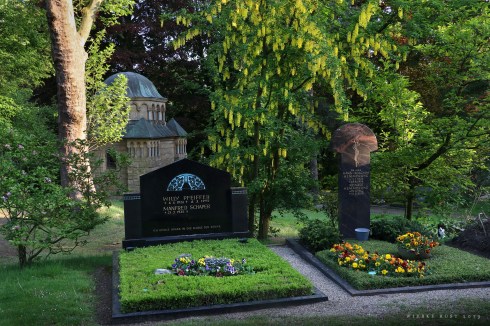
The graveyard is the closest nearby place, where I can enjoy a bit of calm and solitude. There are wild parts, reminiscent of English landscape gardens, which occur quite magical to the senses. On the other hand, the majority of graves is fostered with an accuracy resembling that of miniature baroque gardens. The ballast bed trend is also taking over people’s last place of rest. There are exceptions, with lush planting gone wild, such as the grave covered in columbine, which is pictured above.

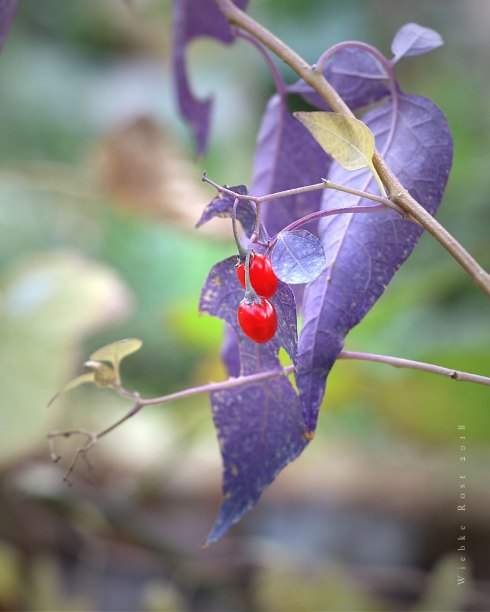
The caretakers seem to employ ecological concepts and care for biodiversity. E.g. I found an abandoned sandy part, previously covered in black nightshade, and now filled with fragrant phacelia, which is a soil conditioner and attracts a multitude of pollinating insects, not only honey bees. There are bee hives being implemented on this graveyard. There is a small pond visited by various water fowl as well grey herons and I spotted at least one large bird of prey, a common buzzard. The entrance on one side smells heavily like fox. There is a huge population of rabbits digging burrows all across the graveyard, which is probably not to the liking of all bereaved, but partly amusing to observe.

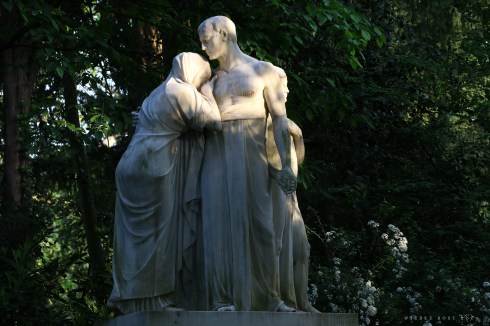
There is an abundance of large and impressive family grave sites as well as memorials for the victims of WWI and WWII. The annexed stonemason does an admirable job with the restoration of the historical grave sites.

It is easy to become enticed by the romanticism conveyed through the abundance and sheer beauty of the place and its funerary art.
As much as I am occupied with the topic of death and the dead, I am part of a generation that will likely not enjoy the luxury of such post-mortem vanity. In truth, it has always been only a small part of humanity to take part in such luxury. Further, the fate of today’s youth is likely, to dissolve into spirit and not leaving much traces of physical existence behind. The larger mankind grows, the less space it will have for its exponentially growing amount of bodies. Neither are the monuments built over decades to last forever. However, they help to implement and strengthen the status of a few over a certain period.

2 centuries of opulent European grave culture, between the modern world and the past, between ego obsessions and spiritual ideals, between emotions and the need for detachment. A boundary between, and – perhaps most importantly – a place for old trees and a green lung for an ever expanding urban space.

Nordfriedhof Düsseldorf

10 May

May 7th, 2019, Nordfriedhof Düsseldorf

Camellia Flower Tincture

6 Apr

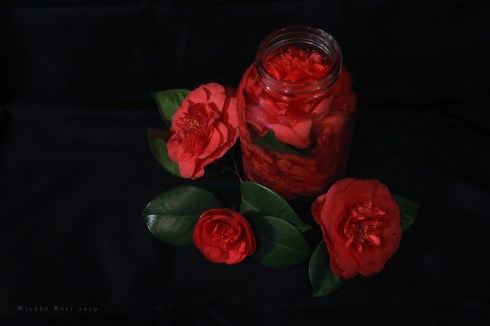
Friday evening is tincture time

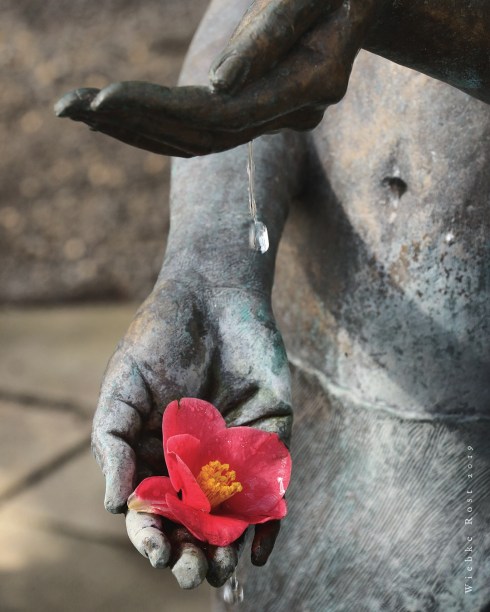
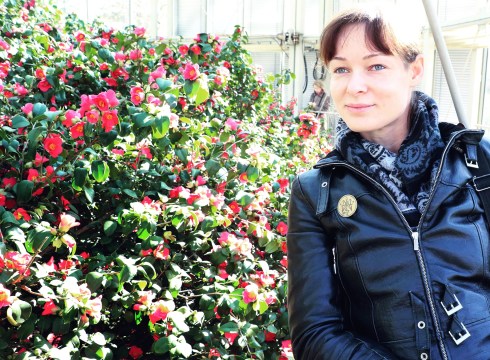
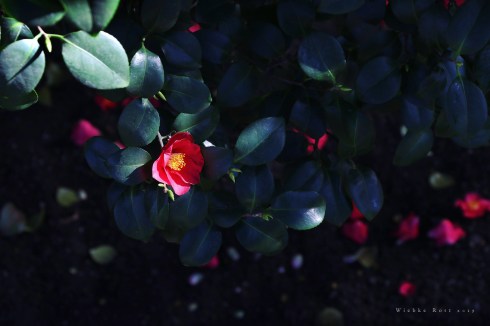
Kamelienblüte Schloss Pillnitz, Frühlingsanfang 2019

22 Mar

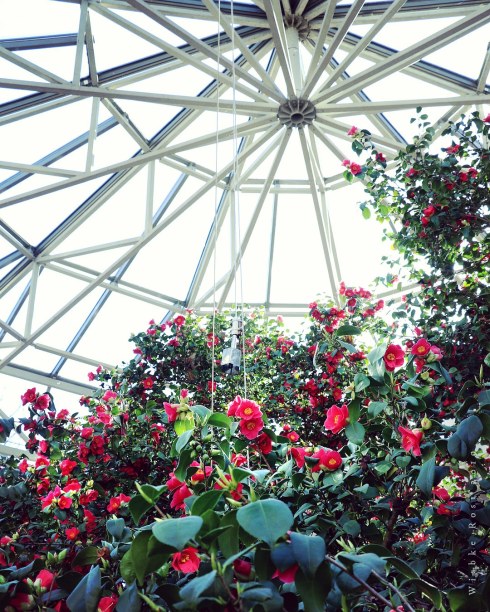
The camellia in Pillnitz is around 230 years old, almost 9 m high and 11 m in diameter. From February to April it is covered in carmine red flowers. During the cold season, the tree, which was planted in 1801 by court gardener Terscheck, is protected by a large glass house with stairs. During this time visitors can enter and view the tree from two levels.

In the mid 19th century Dresden became a European hot spot for the culture and breeding of camellias, and exported them to Russia as well as Italy and Spain. The camellia was viewed as a status symbol among European aristocrats, and Russians in particular, had a high demand for camellia flowers, which were exported in thousands to St. Petersburg and Moscow.

With growing popularity among Westerners, and contrary to its Far Eastern symbolism, the meaning of the flower changed. Thanks to popular literature, most prominently La dame aux camélias by Alexandre Dumas from 1848, as well as real life personae, such as the “Wiener Cameliendame”, a dancer named Fanny Elßler, the camellia became erotizised!

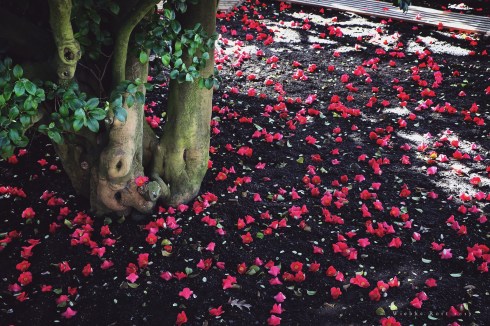
On the other hand the longevity of the flowers, and particularly white camellia flowers, became associated with death and mourning and were woven into funeral wreaths.

The seeds of all known (about 200) camellia seeds yield a valuable oil, which smoothes the hair and juvenates the skin. The oil is rich in linolenic acid, and is also used in cooking and reduces cholesterine. Samurai rubbed camellia oil unto their sword blades to protect them from rust. The oil is also used as a natural surface finish for wood, as lube in watches and precision engineering and more.

Camellia wood is hard and durable and was used in the manufacture of weapons, different tools as well as kokeshi dolls. Up to the Edo period, a camellia rod was used in Buddhist ceremony to punish and drive out malign spirits. The wood also yielded a spark-free and, hence sought after charcoal.

Camellias are highly resistant against diseases and may contain different antibacterial and fungicidal agents.

Besides, the first Westerner to portrait a camellia flower was likely a Saxon gardener by the name George Meister. His book “Der Orientalisch-Indianische Kunst- und Lust-Gärtner” was published in 1692 in Dresden. In it he describes both the camellia as well as its crop plant, Camellia sinensis var. sinensis – the tea shrub!

Further Reading:

Geschichte & Verwendung von Kamelien


https://de.wikipedia.org/wiki/Pillnitzer_Kamelie
https://www.schlosspillnitz.de/de/schloss-park-pillnitz/kamelie/

Nordfriedhof, January 2019

23 Jan

Nordfriedhof Düsseldorf, January 11th, 2019

Fall 2018

5 Nov

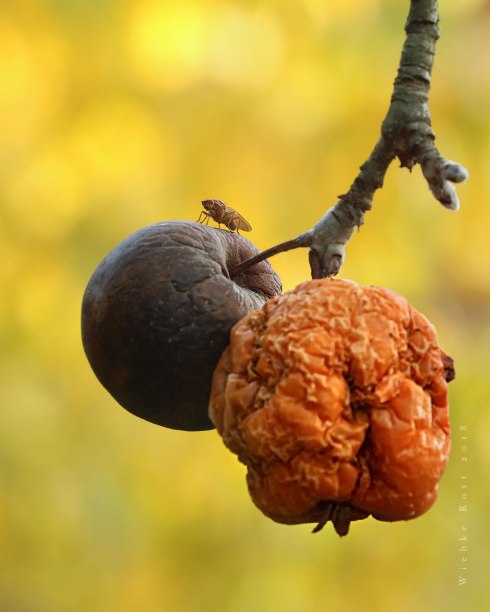
Fall is here, death is here, but the flowers keep on flowering

Regina Bombina, Golden Bee Pendant, The Sacred Bee

14 Oct

“Regina Bombina”, ink, 2017

Totemic artwork, first show-cased at Circle1 gallery in Berlin last year. It is my homage to the great mother and queen, as she has been depicted in the form of crowned bees or half human half bee shaped spirits in ancient civilizations. She is surrounded by her servants, little bee demons.

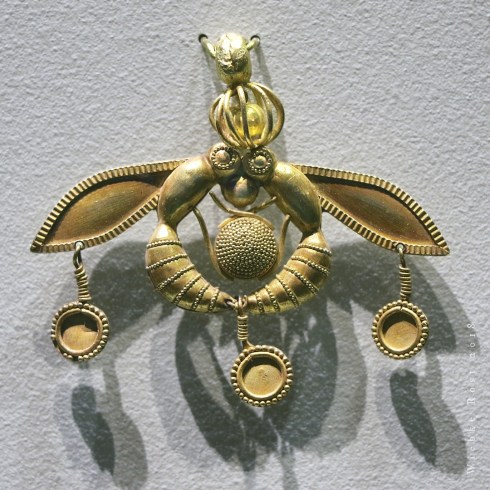
Golden Bee Pendant, Malia, Crete, 1800-1700 BC

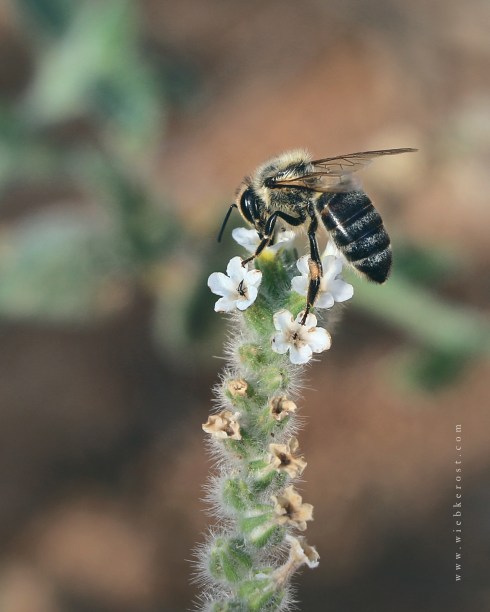
Honey Bee, Malia, Crete, 2018

“The Sacred Bee”, Hilda M. Ransom, Dover Press, 2004

“The Sacred Bee”, Hilda M. Ransom, Dover Press, 2004

After seeing the golden bee pendant from Malia in person, I started a new read: “The sacred Bee” by Hilda M. Ransom. It discusses the mythology and folklore of bees in ancient civilizations across the world and also features a chapter on the roll bees played in ancient Cretan life and worship practice. I am hence delving deeper into the concept behind my “Regina Bombina” and “Flower Devils“.

Perseids

15 Aug

The Perseids are a prolific meteor shower associated with the comet Swift–Tuttle. The meteors are called the Perseids because the point from which they appear to hail (called the radiant) lies in the constellation Perseus. The name is derived from the word Perseidai (Greek : Περσείδαι), the sons of Perseus in Greek mythology.

What we see as “shooting stars” is actually a cloud of debris – tiny pieces ejected by the comet Swift-Tuttle, as it travels along its 133 year orbit around the sun. These particles burn up in the earth’s atmosphere at around 80 km height. They are visible every year from July to August and reach maximum activity between August 9-14, depending on the location of the stream. During the peak, the rate of meteors reaches 60 or more per hour.

They can be seen all across the sky; however, because of the shower’s radiant in the constellation of Perseus, the Perseids are primarily visible in the Northern Hemisphere. [from Wikipedia]

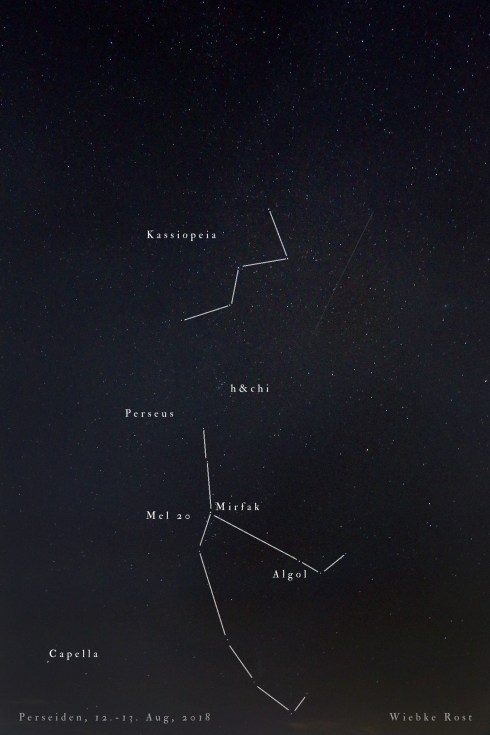
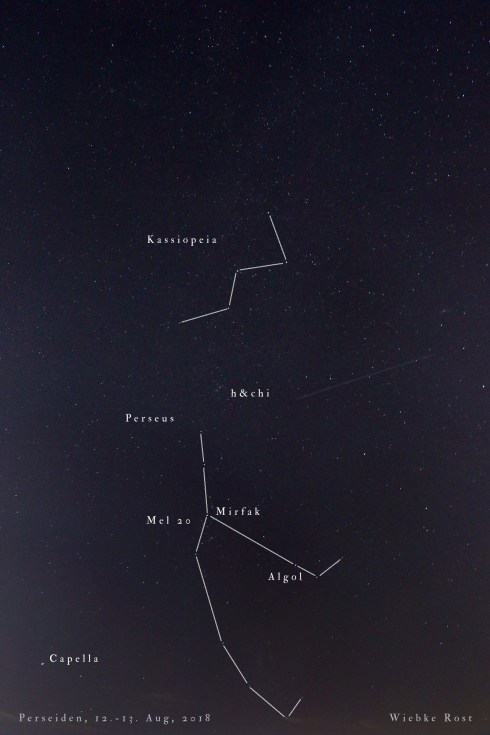
Shown above are photos from my first attempt at capturing the “Perseids”. They occurred in pretty much all directions and I saw some brilliant trains high in the sky as well as fireballs just short above the horizon line. But it was difficult to photograph them.

I set up the camera towards the North East and the constellation Perseus, with the widest angle available (f 18 mm) and 30 seconds exposure time. And then I spent the following 2 hours pressing the shutter every 30 seconds…

The camera did capture a few Perseids as well as plenty of planes. The difference is that a plane shows a twofold and non-continuous light trace (because the plane lights blink periodically) whereas the train of a meteor shows as a thin, continuous bright line on the photo.

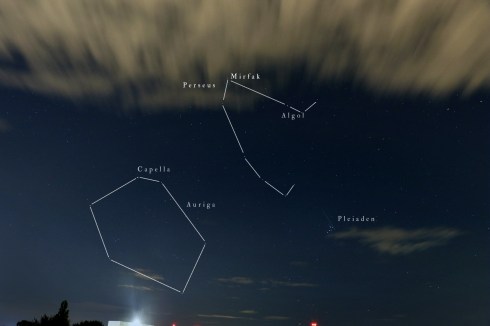
Later that night Auriga rose in the North and the Pleiades became visible in the North East. The camera caught a small train directly above the Pleiades.

Around 2 am the sky started to cloud and my photo session ended.

In the photos I marked some of the constellations and stars for orientation. I hope you enjoy this little excursion. I recommend to check this website for further reading: https://sternenhimmel-fotografieren.de/sternbild-perseus-perseiden-h-und-chi-herz-und-seele-herznebel-sternschnuppen-finden-beobachten-fotografieren/

Gallery

Botanical Garden Düsseldorf

8 May
Gallery

Flowers of Death

7 May