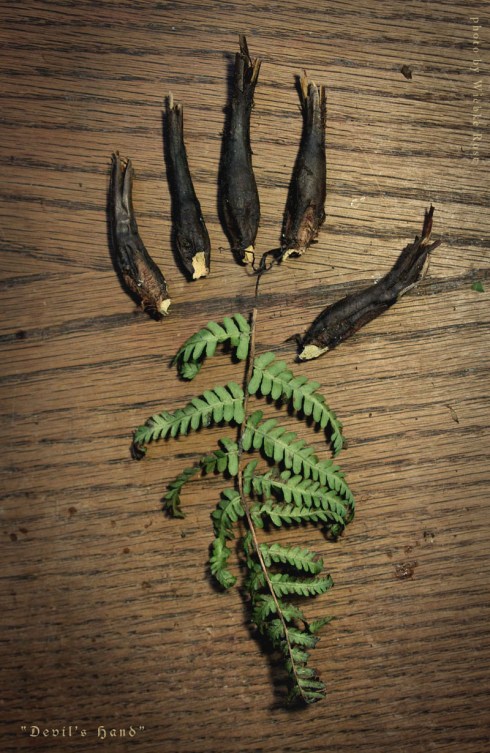
This time it is not about a surreal dream and also not about the fennel. But it is about another plant’s “fingers”. In folklore the male fern’s “hand” is a lucky charm, meant to bestow fortunes and the power over the souls of the dead to it’s owner. In order to obtain it, the sorcerer must harvest the male fern’s root on the Eve of St. John. Then he must roast the root in the fire. The hand is made in such manner as to bind five strands of the fronds together: the root base of the stem is left attached and the rest of the frond’s foliage is removed. The result resembles a “hand”, with tendons (hairy stems) and fingers (stipe bases). Frankly, I never made such “hand” in this manner. But I’ve gathered plenty of male fern roots and had the most magical experiences granted through working with these roots in various ways, always discovering new aspects to this wondrous plant. Above is another version of this “lucky hand”, formed by the stipe bases and a single frond.
Btw., the stipe bases of the male fern’s fronds are green and spongy towards the center, whereas as the outer (old) parts turn black and rot. So if you were to use the root, make sure you actually use the parts that still have juices in them. Below is a close-up of how that should look:
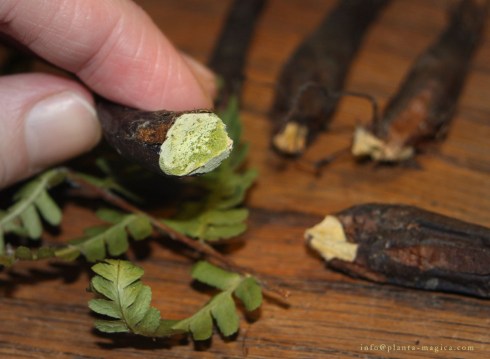
Male Fern stipe base, light green in color and of a spongy texture

Male fern root: in the bowl are the vital parts, to the left are the rotten parts
More about the male fern
Male fern inspired art:
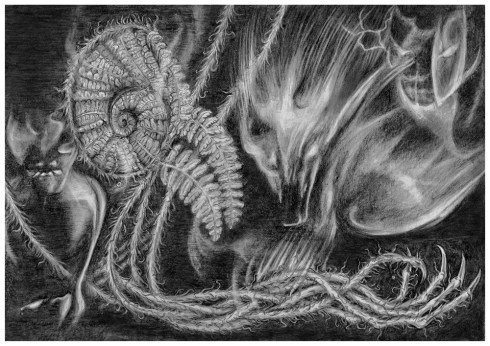
“Dead Man’s Eve”, pencil drawing, 2010
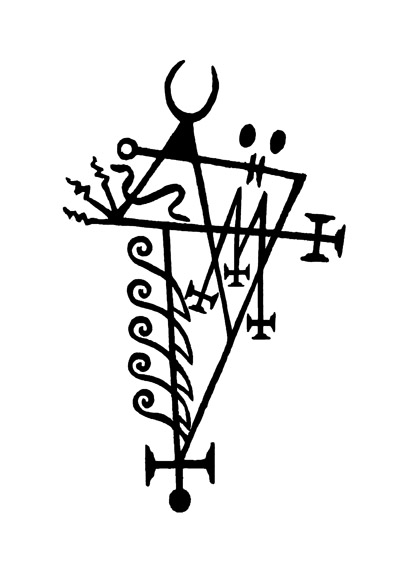
Male Fern plant sigil, 2010
Tags: botany, charms, devils hand, drawings, dryopteris filix-mas, fingers, folklore, herb charm, herbal charm, horror, illustration, lucky hand, magic plants, Magische Pflanzen, male fern, Male Fern Hand, pencil drawings, Pflanzenkunde, pflanzenkunst, Pflanzenmagie, plant folklore, plant lore, plant magic, plant sigils, Planta Magica, plants, plants in legend, poisonous plants, rituals, sigil art, Sigilla Magica, Sigilla Magica Plantarum, sigils, sorcery, visions, worm fern, Wurmfarn



 Wiebke Rost